经典变幅杆
目录
- 图
- 图 1. 棱柱形变幅杆的性能
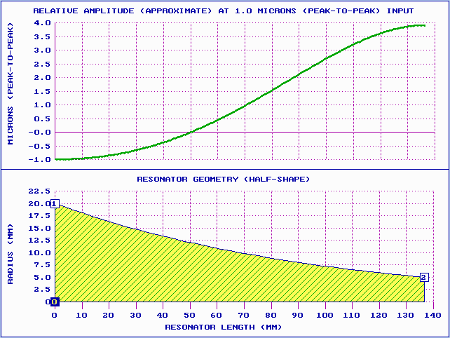
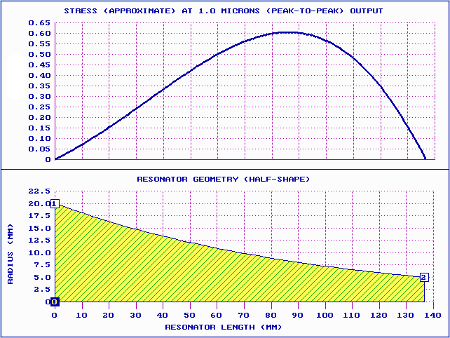
- 图 2. 锥形变幅杆的性能(理论)
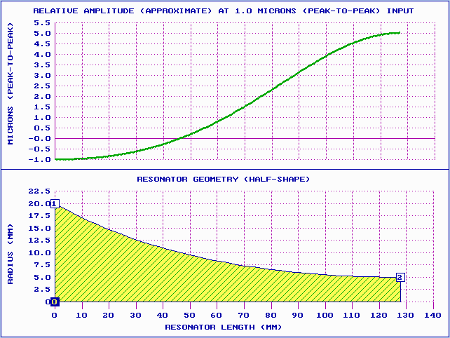
- 图 3. 指数形变幅杆的性能(理论)
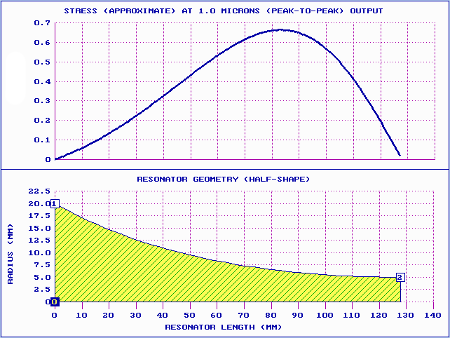
- 图 4. 悬链线形变幅杆的性能(理论)
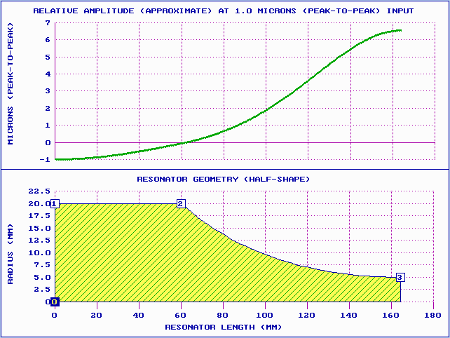
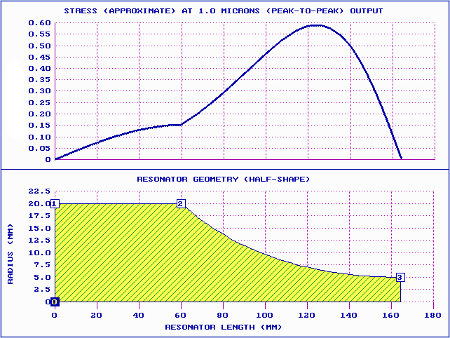
- 图 5. 悬链线形变幅杆的性能(20 kHz,带 60 mm 肩部)
- 表
- 表 1. 性能比较
- 表 2. 悬链线形变幅杆性能比较(20 kHz,无肩部与带肩部)
理论变幅杆
经典变幅杆是指具有单一外表面(即可用单个数学方程描述的表面)、且其理论性能可由一维波动方程数学推导得出(忽略泊松比的所有影响)的变幅杆。经典变幅杆包括棱柱形(无外形)、指数形、悬链线形和锥形。
(注 — 还有其他表面方程,例如多项式,也可以描述单一表面。然而,一维波动方程对这类表面可能无法求解。)
棱柱形(无外形)
详见……
锥形
指数形
悬链线形
性能比较
|
|
| 变幅杆 |
调谐长度 |
增益 |
相对应力 |
| 棱柱形 |
1.00 |
1.00 |
1.00 |
| 锥形 |
1.16 |
3.15 |
0.57 |
| 指数形 |
1.09 |
4.00 |
0.60 |
| 悬链线形 |
1.02 |
5.15 |
0.66 |
|
表注 —
- 棱柱形变幅杆的所有数值均取名义值 1.00 无量纲单位。这样其他变幅杆的性能就可以直接与作为基准的棱柱形变幅杆比较。例如,锥形变幅杆的长度比棱柱形变幅杆高 16%,增益是其 3.15 倍。
- 振幅均相对于共同的输入振幅 1.0。于是变幅杆的增益就是振幅图最右端的振幅(即输出振幅)。
- 应力均相对于共同的输出振幅(而非输入振幅),因为执行应用的是输出振幅。例如,在相同输出振幅下,锥形变幅杆中的应力是棱柱形变幅杆的 57%(即低 43%)。
- 尽管表中的性能是针对 20 kHz 示例变幅杆确定的,但其相对性能在任何频率下都相同。
- 图中结果标注为 "近似",是由其确定方式所致。不过,这些结果与理论值非常接近。
实用变幅杆
上述理论变幅杆并不实用,因为它们没有将其紧固到另一谐振器上的手段(如扳手孔或扳手平面)。紧固手段通常要求在变幅杆后部有一个棱柱形肩部。对于传统的锥形和指数形变幅杆,这些肩部通常相当短(例如 20 kHz 变幅杆为 12 mm)。这样短的肩部不会对变幅杆的性能产生显著影响。
另一方面,悬链线形变幅杆的肩部一般非常长,通常约为四分之一波长(对大多数声学材料,20 kHz 时约为 60 mm)。与上述理论悬链线形变幅杆相比,这将显著影响实用悬链线形变幅杆的性能。
|
图 5. 悬链线形变幅杆的性能
(20 kHz,带 60 mm 肩部) |
|
| 表 2. 悬链线形变幅杆性能比较(20 kHz,无肩部与带肩部) |
|
| 变幅杆 |
调谐长度 |
增益 |
相对应力 |
| 悬链线形(无肩部) |
1.02 |
5.15 |
0.66 |
| 悬链线形(60 mm 肩部) |
1.31 |
6.54 |
0.60 |
|
Classic horns
Contents
- Figures
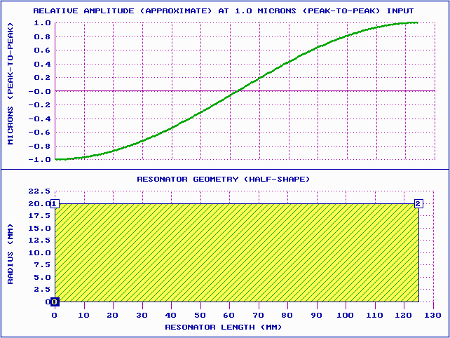
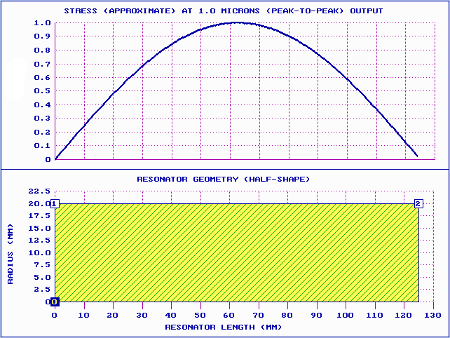
- Figure 1. Prismatic horn performance
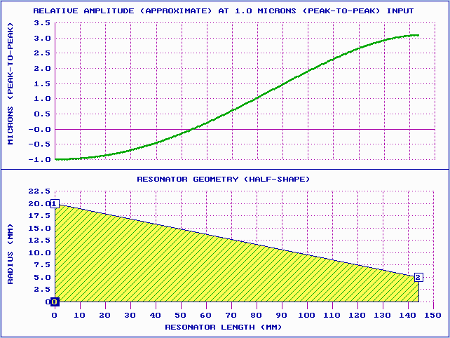
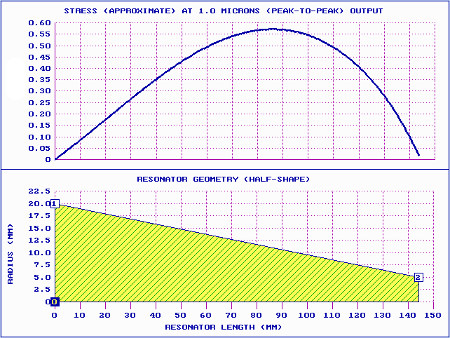
- Figure 2. Tapered horn performance (theoretical)
- Figure 3. Exponential horn performance (theoretical)
- Figure 4. Catenoidal horn performance (theoretical)
- Figure 5. Catenoidal horn performance (20 kHz with 60 mm shoulder)
- Tables
- Table 1. Performance comparisons
- Table 2. Catenoidal horn performance comparisons (20 kHz without and with shoulders)
Theoretical horns
Classic horns are those with a single exterior surface (i.e., a surface that can be described by a single mathematical equation) and whose theoretical performance can be mathematically derived from the one-dimensional wave equation (ignoring all effects from Poisson's ratio). Classic horns include prismatic (unshaped), exponential, catenoidal, and tapered.
(Note — There are other surface equations, such polynomials, that can describe a single surface. However, the one-dimensional wave equation may not be solvable for such surfaces.)
Prismatic (unshaped)
|
| Figure 1. Prismatic horn performance |
|
Details ...
Tapered
|
| Figure 2. Tapered horn performance (theoretical) |
|
Exponential
|
| Figure 3. Exponential horn performance (theoretical) |
|
Catenoidal
|
| Figure 4. Catenoidal horn performance (theoretical) |
|
Performance comparisons
| Table 1. Performance comparisons |
|
| Horn |
Tuned length |
Gain |
Relative stress |
| Prismatic |
1.00 |
1.00 |
1.00 |
| Tapered |
1.16 |
3.15 |
0.57 |
| Exponential |
1.09 |
4.00 |
0.60 |
| Catenoidal |
1.02 |
5.15 |
0.66 |
|
Table notes —
- All values for the prismatic horn have nominal values of 1.00 nondimensional units. Then the performance of the other horns can be directly compared to the nominal prismatic horn. For example, length of the tapered horn is 16% higher than the prismatic horn and the gain is 3.15 greater.
- The amplitudes are relative to a common input amplitude of 1.0. Then the horn gain is just the right-most amplitude on the amplitude graph (i.e., the output amplitude).
- The stresses are relative to a common output amplitude (rather than the input amplitude) since this is the amplitude that performs the application. For example, for the same output amplitude the the stress in the tapered horn is 57% as great (i.e., 43% lower) as the prismatic horn.
- Although the performances in the table were determined for 20 kHz example horns, the comparative performances will be the same at any frequency.
- The graphed results are labeled as "approximate" because of the way they were determined. However, these results are very close to the theoretical values.
Practical horns
The above theoretical horns are not practical because they don't have means to tighten them to another resonator (e.g., spanner wrench holes or wrench flats). The tightening means typically require a prismatic shoulder at the back of the horn. For traditional tapered and exponential horns these shoulders have typically been fairly short (e.g., 12 mm for a 20 kHz horn). Such short shoulders would not have a significant impact on the horn's performance.
On the other hand, catenoidal horns have generally had very long shoulders, typically about a quarter wavelength (approximately 60 mm at 20 kHz for most acoustic materials). This will significantly affect the performance of the practical catenoidal horn compared to the theoretical catenoidal horn above.
|
Figure 5. Catenoidal horn performance
(20 kHz with 60 mm shoulder) |
|
| Table 2. Catenoidal horn performance comparisons (20 kHz without and with shoulders) |
|
| Horn |
Tuned length |
Gain |
Relative stress |
| Catenoidal (no shoulder) |
1.02 |
5.15 |
0.66 |
| Catenoidal (60 mm shoulder) |
1.31 |
6.54 |
0.60 |
|