钨的性能
目录
- 插图
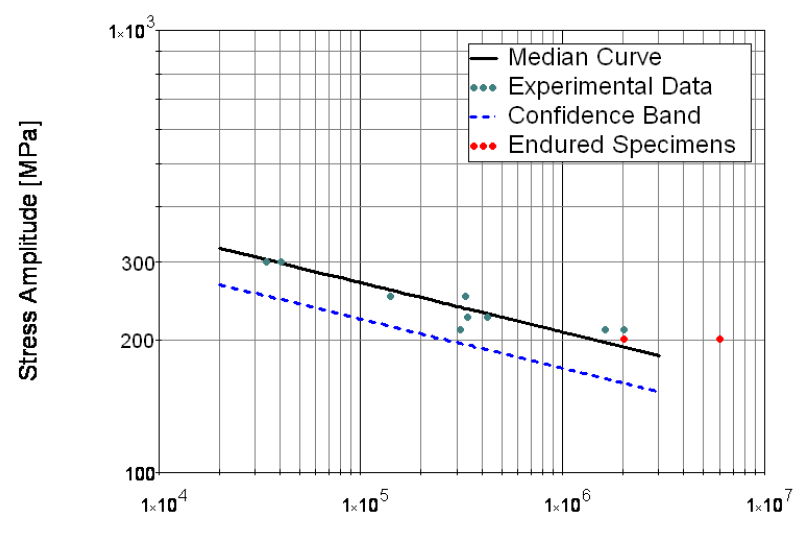
- 图 1. 钨 Inermet IT180 的疲劳数据
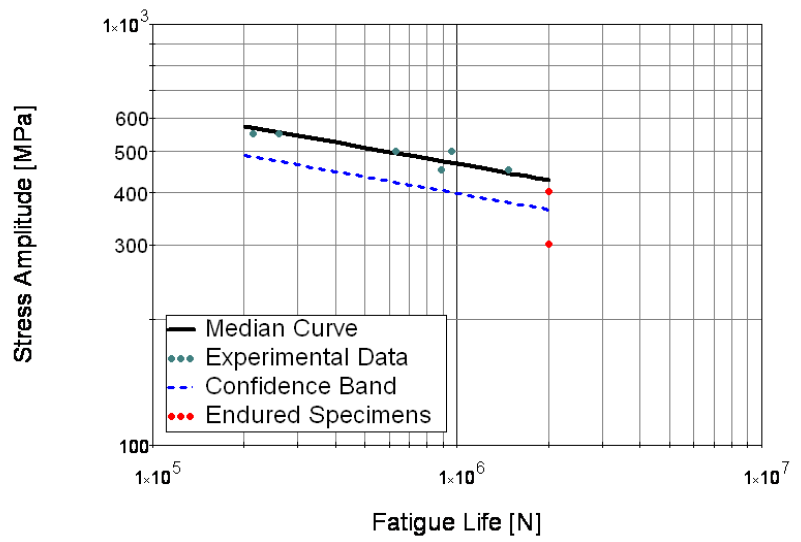
- 图 2. 钨 Densimet D176 的疲劳数据
- 表格
- 表 1. 钨及其合金的谐振器应用
- 表 2. Inermet IT180 的性能
- 表 3. Densimet D176 的性能
谐振器应用
|
|
| 性能 |
应用 |
极高的熔点
(例如,纯钨为 3420°C) |
|
高密度
(例如,纯钨为 19300 kg/m3) |
|
|
合金
下面讨论的钨合金(Inermet IT180 和 Densimet D176)之所以被选中,是因为有一些有限的疲劳数据可用。其他钨合金也可能提供相当或更好的超声性能。
除非另有说明,以下信息来自 López and Paez[1] 或制造商(Plansee[1] — 见数据手册)。
这些烧结合金由球状钨晶粒和将晶粒粘结在一起的连续韧性基体(通常为镍和铁,或镍和铜)组成。这些材料通过液相粉末金属烧结制成(第 4 页 — 详见该处)。"一般来说,力学性能强烈地受最终钨晶粒尺寸、形状和接触程度的影响。而这些又同时受钨含量、烧结温度和时间的影响。"(第 5 页)
所有疲劳数据均来自低频(即非超声)轴向全反复加载。(第 6 页)试样经过磨削和抛光,但仍残留一些表面粗糙度和孔隙。(第 24、38-39 页)作者指出:"材料的疲劳响应强烈地受表面粗糙度、残余孔隙率、孔隙尺寸和孔隙分布的影响。"(第 ii 页)另请注意试样数量很少。因此,将疲劳结果推广到材料总体时必须谨慎。
Inermet IT180
|
|
成分
(按重量) |
95% W, 3.5% Ni, 1.5% Cu |
López,第 1 页 |
| 硬度 (HB30) |
275 |
Plansee,第 7 页 |
| 密度 (kg/m3) |
18000 |
López,第 27 页 |
| 杨氏模量 (GPa) |
308(López,实测)
360(Plansee 数据) |
López,第 51 页 |
| 泊松比 |
0.28(基于纯钨) |
|
细丝波速
(m/sec) |
4140(基于实测数据)
4470(基于 Plansee 数据) |
计算值 |
估计疲劳极限
(MPa) |
210 |
López,第 ii 页 |
|
Densimet D176
|
|
成分
(按重量) |
92.5% W, 5.0% Ni, 2.5% Fe |
López,第 1 页 |
| 硬度 (HB30) |
285 |
Plansee,第 7 页 |
| 密度 (kg/m3) |
17600 |
López,第 27 页 |
| 杨氏模量 (GPa) |
309(López,实测)
360(Plansee 数据) |
López,第 51 页 |
细丝波速
(m/sec) |
4190(基于实测数据)
4520(基于 Plansee 数据) |
计算值 |
估计疲劳极限
(MPa) |
425 |
López,第 ii 页 |
|
磨损应用
钨及其合金已被评估用于改善微动磨损(例如,用于超声金属焊接中的端头和砧座)。
Tungsten Properties
Contents
- Figures
- Figure 1. Fatigue data for tungsten Inermet IT180
- Figure 2. Fatigue data for tungsten Densimet D176
- Tables
- Table 1. Resonator applications for tungsten and its alloys
- Table 2. Properties of Inermet IT180
- Table 3. Properties of Densimet D176
Resonator applications
| Table 1. Resonator applications for tungsten and its alloys |
|
| Property |
Applications |
Very high melting temperature
(e.g., 3420°C for pure tungsten) |
- Horns for ultrasonic processing of liquid metals
|
High density
(e.g., 19300 kg/m3 for pure tungsten) |
- Transducer back driver assemblies in order to shorten the overall transducer length and improve static prestress distribution across the ceramics
- Resonators with increased gain (relative to stress) and reduced modal interaction — see Ehlert[1] patent 8,459,122 B2
|
|
Alloys
The following tungsten alloys (Inermet IT180 and Densimet D176) are discussed because some limited fatigue data are available. Other tungsten alloys may possibly provide equal or better ultrasonic performance.
Unless otherwise indicated, the following information is from López and Paez[1] or the manufacturer (Plansee[1] — see data sheet).
These sintered alloys have spherical tungsten grains in a continuous ductile matrix (typically, nickel and iron or nickel and copper) bonding the grains together. These materials are produced by liquid phase powder metal sintering (p. 4 — see details there). "In general, the mechanical properties are strongly influenced by the final tungsten grain size, shape and contiguity. These are, at the same time, influenced by the tungsten content, sintering temperature and time." (p. 5)
All fatigue data are from low-frequency (i.e., non-ultrasonic) axial fully-reversed loading. (p. 6) The specimens were ground and polished although some surface roughness and pores remained. (pp. 24, 38-39) The authors note, "The fatigue response of the material[s] is strongly affected by surface roughness, residual porosity, pore size and pore distribution." (p. ii) Also note the small number of specimens. Thus, care must be used when extending the fatigue results to the general material population.
Inermet IT180
| Table 2. Properties of tungsten Inermet IT180 |
|
Composition
(by weight) |
95% W, 3.5% Ni, 1.5% Cu |
López, p. 1 |
| Hardness (HB30) |
275 |
Plansee, p. 7 |
| Density (kg/m3) |
18000 |
López, p. 27 |
| Young's modulus (GPa) |
308 (López, measured)
360 (Plansee data) |
López, p. 51 |
| Poisson's ratio |
0.28 (based on pure tungsten) |
|
Thin-wire wave speed
(m/sec) |
4140 (based on measured data)
4470 (based on Plansee data) |
Calculated |
Fatigue limit, estimated
(MPa) |
210 |
López, p. ii |
|
Densimet D176
| Table 3. Properties of tungsten Densimet D176 |
|
Composition
(by weight) |
92.5% W, 5.0% Ni, 2.5% Fe |
López, p. 1 |
| Hardness (HB30) |
285 |
Plansee, p. 7 |
| Density (kg/m3) |
17600 |
López, p. 27 |
| Young's modulus (GPa) |
309 (López, measured)
360 (Plansee data) |
López, p. 51 |
Thin-wire wave speed
(m/sec) |
4190 (based on measured data)
4520 (based on Plansee data) |
Calculated |
Fatigue limit, estimated
(MPa) |
425 |
López, p. ii |
|
Wear applications
Tungsten and its alloys have been evaluated to improve fretting wear (e.g., for tips and anvils in ultrasonic metal welding).