剪切模态变幅杆
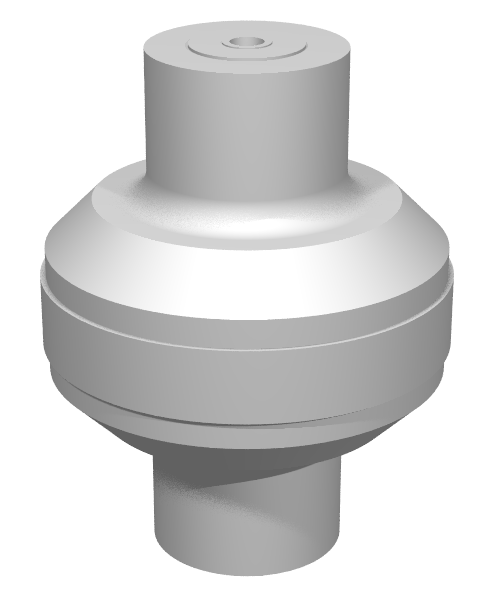
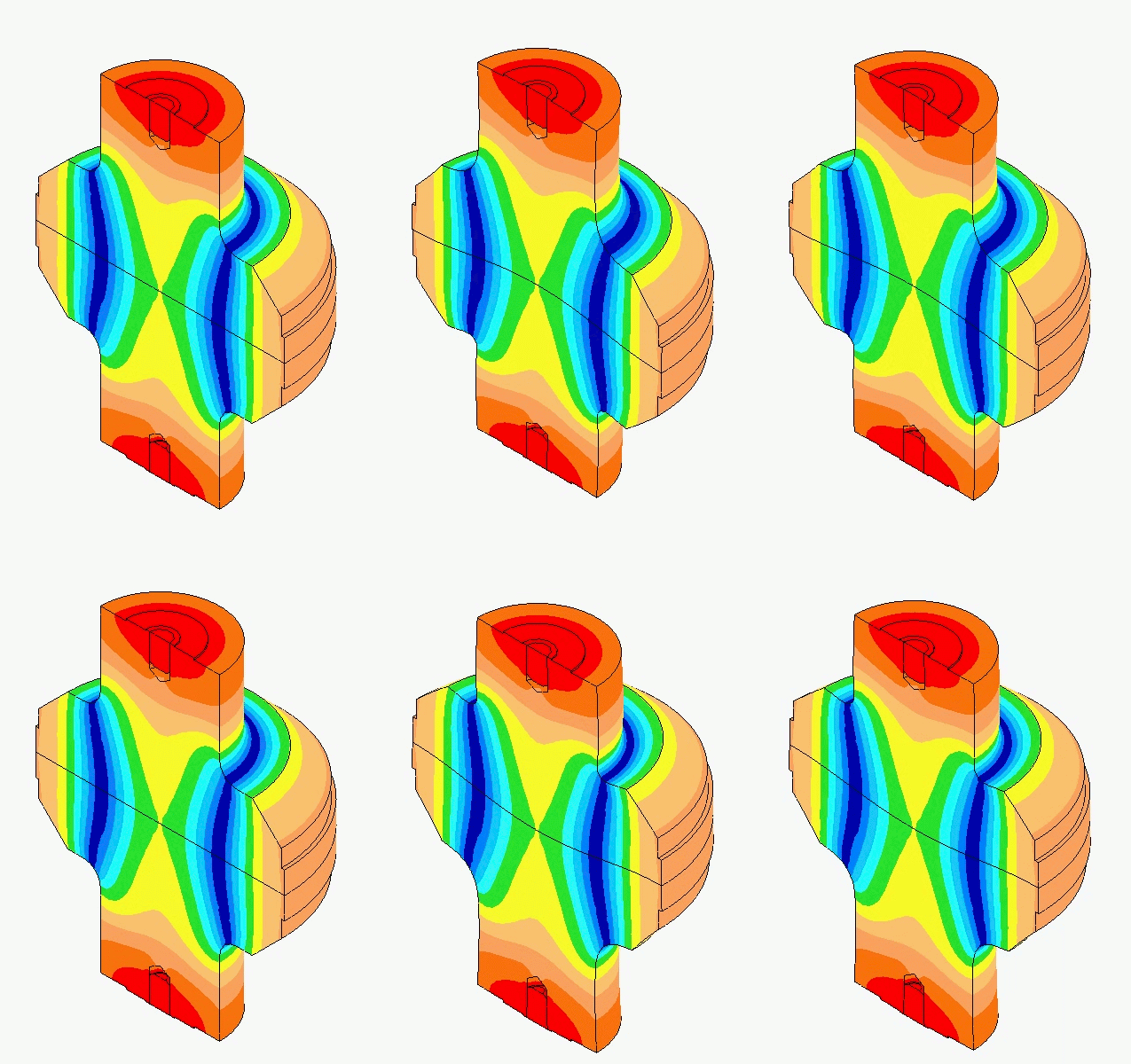
以下是一个以剪切模态工作的变幅杆示例,其波节是与螺柱轴线同心的圆柱面。(与之相对照,纵向谐振器的波节通常是与螺柱轴线垂直的平面。)
|
||||||||||
|
应用 — 超声增材制造(UAM)
类似的设计已用于超声增材制造(见 White 专利)。变幅杆两端各由一根增幅杆支撑。变幅杆旋转的同时横向掠过一条薄带状焊接材料,从而将该带材焊接到下层结构上。
注:Graff (1) 采用了另一种剪切模态变幅杆设计,无需支撑增幅杆。
对于 UAM,周边焊接表面必须做粗糙化处理;粗糙的类型和程度必须通过实验确定。
由于剪切摩擦运动,焊接表面最终会磨损,尤其是在焊接较硬材料时。如果变幅杆振幅足够低,则变幅杆可以用钢而不是钛制造。或者,也可以在钛变幅杆上施加耐磨涂层(例如参见 D-Gun)。这种涂层还可能同时提供所需的粗糙度。
设计
- 该变幅杆的材料为 Ti-6Al-4V。假设的材料属性 —
E = 121.9 GPa
密度 = 4425 kg/m³
泊松比 = 0.34 - 在 20 kHz 下,变幅杆长度为 190 mm,直径为 146 mm。较大的直径使周边剪切焊接区与相邻支撑设备之间留有空隙。
- 调谐 — 从两端等量调谐。每端的调谐速率约为 120 Hz/mm。
性能
- 增益为 0.7。
- 钛材的最大 von Mises 应力(8.4 MPa/(焊接表面处微米_峰值))出现在波节汇入 10 mm 圆角处。
- 焊接表面存在 2% 的摇摆运动(相对于其剪切运动)。当输入与输出圆柱的直径与剪切波节大致相同时,摇摆似乎最小。17 mm 倒角减小时,摇摆会增大。
- 最近的相邻谐振(不含弯曲模态) — 18457 Hz、23874 Hz
下载此设计
Shear mode horn
The following is an example of a horn that operates in a shearing mode where the node is a cylinder concentric to the stud axis. (Contrast this with a longitudinal resonator where the node is a plane that is generally perpendicular to the stud axis.)
|
||||||||||
|
Application — Ultrasonic additive manufacturing (UAM)
A similar design has been used in ultrasonic additive manufacturing (see White patent). The horn is supported with booster at each end. The horn rotates and simultaneously traverses a thin strip of welding material, thereby welding the strip to the underlying structure.
Note: Graff (1) uses an alternate shear mode horn design that does not require supporting boosters.
For UAM the peripheral welding surface must be roughened; the type and degree of roughness must be determined experimentally.
Because of the shear scrubbing motion the welding surface will eventually wear, especially when welding harder materials. If the horn amplitude is sufficiently low then the horn could made of steel instead of titanium. Alternately, a wear coating could be applied to the titanium horn (see, for instance, D-Gun). Such a coating might also supply the required roughness.
Design
- The material for this particular horn is Ti-6Al-4V. Assumed material properties —
E = 121.9 GPa
Density = 4425 kg/m³
Poissons ratio = 0.34 - At 20 kHz the horn length is 190 mm and the diameter is 146 mm. The large diameter allows clearance between the peripheral shear welding area and adjacent supporting equipment.
- Tuning — Tune equally from each end. The tuning rate is ~120 Hz/mm at each end.
Performance
- The gain is 0.7.
- The maximum von Mises stress for titanium (8.4 MPa/(micron_peak at the welding surface)) occurs where the node exits into the 10 mm radius.
- The welding surface has 2% rocking motion (compared to its shearing motion). Rocking appears to be minimized when the input and output cylinders have approximately the same diameter as the shear node. Rocking increases as the 17 mm chamfer is decreased.
- Closest adjacent resonances (excluding bending modes) — 18457 Hz, 23874 Hz