电火花加工(EDM)
目录
电火花加工(EDM)是一种利用放电(电火花)熔化和蒸发金属来去除材料的工艺。电火花在导电电极与金属零件之间产生,两者都浸没在绝缘工作液中。绝缘工作液既作为电火花的电离介质,又将电蚀产物冲离切割区域。电火花以高频脉冲形式产生。EDM 一般仅限于导电材料。两种常见类型是线切割电火花加工和成形电火花加工。
线切割电火花加工(WEDM)
在线切割电火花加工中,一根细金属丝在两个卷轴之间连续走丝(图 1)。金属丝保持恒定的预定张力,以尽量减小金属丝的横向振动。金属丝在走丝的同时,还在被加工零件上走出一条轨迹。金属丝直径粗加工时通常为 0.3 mm,精加工时为 0.2 mm。加工钛时优先选用镀锌黄铜丝(Pramanik [1],第 2‑3 页)。
|
|
|
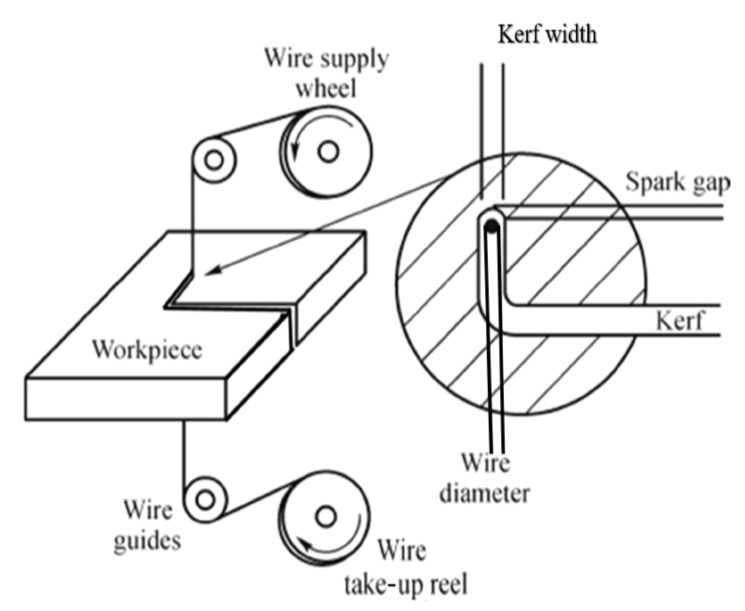
有人建议(并尝试过)用线切割电火花加工在变幅杆上加工槽。然而,与常规机械加工相比,它有几个缺点 —
- 线切割电火花加工可能明显更慢。
- 许多加工厂没有线切割电火花加工设备,因此变幅杆必须送到专业工厂加工。这会增加成本和交货时间。
- 线切割电火花加工会显著降低谐振器的疲劳寿命。
- 对于钛,需要极高的电火花温度(约 20000 °C)(Pramanik [1],第 2 页)。这会损伤电极丝。金属丝在零件中暴露的时间越长,损伤越严重。因此,金属丝进入零件时状态良好,而从零件另一侧出来时状态就相对较差。随着零件厚度增加,金属丝暴露时间更长,且冲洗能力下降,损伤也随之加重。于是,零件顶部的加工较为干净,而底部相对较脏(Pramanik [1],第 2 页)。此外,金属丝的损伤会增大断丝的概率。Pramanik [1] 报告称,加工钛时断丝"非常频繁"(第 3 页)。在大型块形变幅杆(例如厚度达 250 mm)上加工槽时,这些问题很可能都会出现。
切割速度
切割速度较难表征,因为它取决于众多工艺参数和期望的结果,尤其是表面光洁度和疲劳性能。不过总体而言,切割速度与常规机械加工相比很低。在对切割 10 mm x 10 mm x 15 mm 退火态 Ti-6Al-4V 的参数进行优化后,Gupta [1] 报告的最大速度为 1.75 mm/min。按此切割速度,为 20 kHz 钛变幅杆加工一条 100 mm 长 x 10 mm 宽的槽(周长 = 220 mm)大约需要 2 小时。
Pramanik [1](第 4 页)报告称,表面粗糙度几乎随切割速度线性增加。在 2.65 mm/min 时,表面粗糙度为 2.44 μm;超过此值后,表面粗糙度急剧恶化。在 2.65 mm/min 时,加工上述同一条槽大约需要 1.4 小时。
疲劳
就疲劳而言,两个重要的加工考虑因素是表面粗糙度和残余拉应力。常规机械加工的结果主要由刀具速度、进给量、刀具几何形状与材料以及切削液控制。这些参数对许多零件材料而言总体上已被充分理解。相比之下,EDM 工艺参数包括脉冲导通时间、脉冲关断时间、峰值电流、走丝速度、丝张力、火花间隙电压、电极(丝)类型、绝缘工作液、绝缘工作液的冲洗压力以及伺服进给速率(Rao [1],第 2 页)。脉冲形状和频率也会影响性能(Pramanik [1],第 5 页)。对于特定的零件材料,其中许多参数仍在研究之中。下面提供一些信息,但肯定不全面。(Rao 总结了截至 2014 年的许多 EDM 研究。)
在 EDM 过程中,电火花会在零件表面产生高热。其中一部分热量用于熔化和气化零件材料。其余热量要么被绝缘工作液带走,要么传导进入零件内部。由于钛的导热性很差,被加工表面内的温度远高于被加工表面以下的温度。这导致被加工表面的一薄层内产生剧烈的热量。与此同时,这一层又被绝缘工作液淬火。因此,与基体材料相比,被加工表面的性能发生了显著变化。(Pramanik [1],第 2 页)当然,由此产生的表面形貌与常规机械加工不同;此外,表面还可能形成微裂纹。
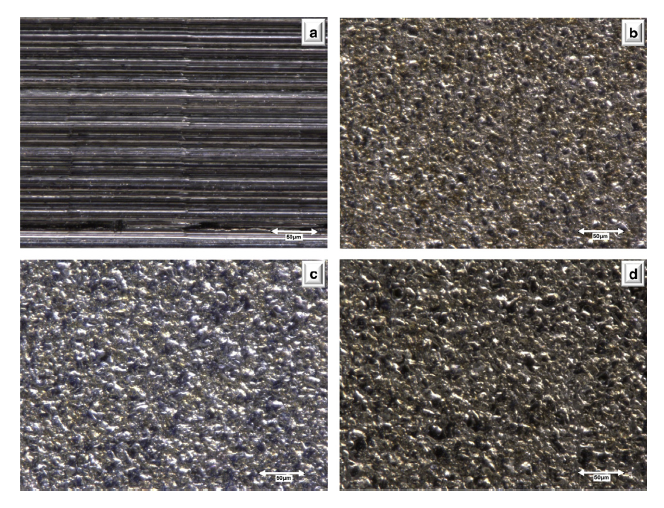
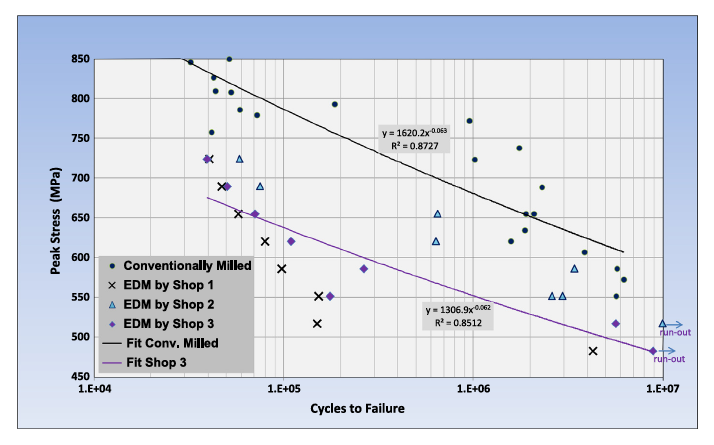
Mower [1] 使用标准 ASTM 试样对 Ti-6Al-4V 进行了拉伸疲劳试验 (\( R \)= 0.1)。这些试样的棱边要么用硬质合金立铣刀常规加工,要么由三家独立的加工厂用各自最优化的(专有)EDM 参数按各自最好的表面光洁度进行 EDM 加工(见图 2)。10 Hz 下的疲劳试验结果如图 3 所示。 利用第 3 家加工厂的数据,Mower 发现 EDM 试样的疲劳强度降低到常规铣削试样的 80%。(有趣的是,第 3 家加工厂的表面光洁度最差,但疲劳性能却介于第 1 家和第 2 家之间。因此,表面光洁度本身并不一定与疲劳性能相关。)不过应当记住,这些试样是为获得最佳表面光洁度而非常精心制备的;实际生产中的加工会产生略为不同的结果,尽管趋势可能相似。(注 — Mower 发现,EDM 的负面影响可以通过电解抛光和/或喷丸强化来消除。然而,这同样会增加成本和交货时间。)
Yeo 在对 4340 钢进行线切割电火花加工时发现了类似的问题。Mower 和 Yeo 都发现,通过喷丸处理(玻璃丸)或喷丸强化可以恢复标称疲劳性能。
|
|
|
|
|
|
锁孔形槽
锁孔形槽实际上只能用线切割电火花加工。然而,即使不考虑线切割电火花加工的缺点,也不推荐锁孔形槽,因为其固有应力高于常规槽。
成形电火花加工
对于刚性安装的增幅杆,成形电火花加工已被用于加工将解耦环带与增幅杆本体隔开的深槽。成形电火花加工也可用于在变幅杆端面上超声应力较低的部位加工细节。不过,常规机械加工通常更快、更便宜。
Electrical Discharge Machining (EDM)
Contents
Electrical discharge machining (EDM) is a process where metal is removed using electrical discharges (sparks) to melt and evaporate the metal. The sparks are generated between a conductive electrode and the metal part, both of which are immersed in a dielectric fluid. The dielectric fluid acts as an ionization medium for the sparks and also flushes the sparked material away from the cutting region. The sparks are pulsed at high frequency. EDM is generally limited to conductive materials. Two common types are wire EDM and sinker EDM.
Wire EDM (WEDM)
In wire EDM a thin metal wire is fed continuously between two spools (figure 1). The wire is kept under constant predefined tension to minimize lateral vibration of the wire. As the wire is fed it also traces a path on the part that is being machined. The wire diameter is typically 0.3 mm for roughing and 0.2 mm for finishing. Brass wire coated with zinc is preferred for machining titanium (Pramanik [1], pp. 2‑3).
|
|
|
Wire EDM has been suggested (and tried) for machining slots in horns. However, there are several disadvantages compared to conventional machining —
- Wire EDM may be significantly slower.
- Many shops don't have wire EDM equipment so the horns must be sent to specialty shops. This increases the cost and delivery time.
- Wire EDM can significantly reduce the resonator's fatigue life.
- For titanium, very high spark temperatures are required (~20000 °C) (Pramanik [1], p. 2). This damages the electrode wire. The damage increases the longer the wire is exposed to the part. Hence, while the wire will be in good condition as it enters the part, it will be in relatively poorer condition as it exits the part on the opposite side. The damage increases as the part thickness increases due to the wire's increased exposure time and also reduced flushing ability. Thus, the machining is cleaner at the top of the part and comparatively dirtier at the bottom (Pramanik [1], p. 2). Additionally, the damage to the wire increases the probability of wire breakage. Pramanik [1] reports that wire breakage in titanium is "very frequent" (p. 3). These problems would likely be present when machining slots in large block horns (e.g., up to 250 mm thick).
Cutting speed
Cutting speed is somewhat difficult to characterize since it depends on the many process parameters and the desired outcome, especially the surface finish and fatigue performance. In general, however, cutting speeds are low compared to conventional machining. After optimized the parameters for cutting 10 mm x 10 mm x 15 mm annealed Ti-6Al-4V, Gupta [1] reported a maximum speed of 1.75 mm/min. Based on this cutting speed, a 100 mm long x 10 mm wide slot (= 220 mm periphery) for a 20 kHz titanium horn would require approximately 2 hours.
Pramanik [1] (p. 4) reported that the surface roughness increased almost linearly with cutting speed. At 2.65 mm/min the surface roughness was 2.44 μm; beyond this the surface roughness detiorated drastically. At 2.65 mm/min the same slot as above would require approximately 1.4 hours.
Fatigue
For fatigue, two important machining considerations are surface roughness and residual tensile stresses. The results of conventional machining are largely controlled by tool speeds, feeds, tool geometry and material, and cutting fluid. These parameters are generally well understood for many part materials. In contrast, EDM process parameters include pulse on-time, pulse off-time, peak current, wire feed rate, wire tension, spark gap voltage, electrode (wire) type, dielectric fluid, flushing pressure of dielectric fluid, and servo feed rate (Rao [1], p. 2). Pulse shape and frequency also affect performance (Pramanik [1], p. 5). Many of these parameters are still under investigation for particular part materials. The following provides some information but is certainly not comprehensive. (Rao summarizes many EDM studies as of 2014.)
During EDM, high heat is generated on the part's surface due to sparking. Some of this heat is used to melt and vaporize the part's material. The remaining heat is either drawn away by the dielectric fluid or conducted into the part. Because titanium has poor conductivity, the temperature in the machined surface is considerably higher than below the machined surface. This causes intense heat in a thin layer of the machined surface. At the same time this layer is being quenched by the dielectric fluid. Thus, the properties of the machined surface change significantly compared to the bulk material. (Pramanik [1], p. 2) Of course, the resulting surface topography differs from that of conventional machining; also, surface microcracks may form.
Mower [1] ran tension fatigue tests (\( R \)= 0.1) on Ti-6Al-4V using standard ASTM test specimens . The edges of these specimens were either conventionally machined with a carbide end mill or were EDM'd by three independent shops to their best surface finish using their best optimized (proprietary) EDM parameters (see figure 2). The results of fatigue tests at 10 Hz are shown in figure 3. Using the data from shop 3, Mower found that the fatigue strength of the EDM'd specimens was reduced to 80% of the conventionally-milled specimens. (Interestingly, shop 3 had the worst surface finish but had intermediate fatigue performance between shop 1 and shop 2. Thus, surface finish by itself does not necessarily correlate to fatigue performance.) It should be remembered, however, that these specimens were very carefully prepared for optimal surface finishes; real-world machining would produce somewhat different results although the trends would likely be similar. (Note — Mower found that the negative effects of EDM could be reversed by electropolishing and/or shot peening. However, this again increases the cost and delivery time.)
Yeo found similar problems with wire EDM of 4340 steel. Both Mower and Yeo found that the nominal fatigue performance could be restored by bead blasting or shot peening.
|
|
|
|
|
|
Keyhole slots
Keyhole slots can only reasonably be machined with wire EDM. However, even without the disadvantages of wire EDM, keyhole slots are not recommended because of they have inherently higher stresses than conventional slots.
Sinker EDM
For rigid-mount boosters, sinker EDM has been used to machine the deep groove that separates the decoupling band from the booster body. Sinker EDM could also be used to machine details on a horn's face where the ultrasonic stress is low. However, conventional machining would typically be faster and less expensive.