线轴形变幅杆
大直径实心圆柱形变幅杆在变幅杆端面边缘处的振幅低于端面中心处的振幅。这是由泊松耦合效应引起的。(详见此处。)
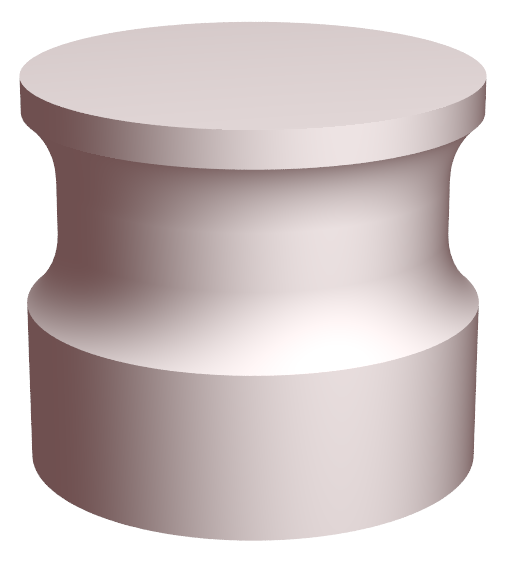
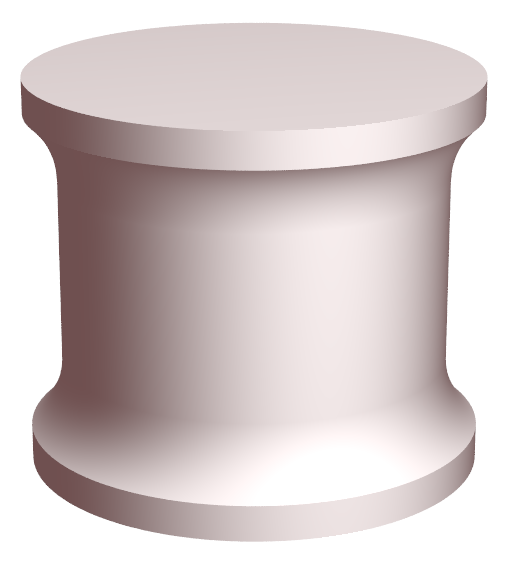
为抵消这一效应,可在端面后方对变幅杆侧面进行底切(开凹槽),从而在前端形成一个法兰。该法兰可增大端面边缘处的振幅,进而提高整个端面上的均匀性。这种变幅杆设计被称为线轴形变幅杆,因为其外形有些像线轴。
由于线轴形变幅杆没有槽,其应力比开槽圆柱形变幅杆低得多,寿命也长得多。此外,线轴形变幅杆具有非常好的端面均匀性:当变幅杆直径小于细杆半波长时,均匀性一般优于 90%。(这不包括会与非对称谐振产生有害相互作用的线轴形变幅杆尺寸(例如 20 kHz 下的 Ø100 mm 线轴形变幅杆))。
随着线轴形变幅杆直径增大,端面的径向振幅也会增大。因此,线轴形变幅杆的最大直径被限制在约一个细杆半波长。
|
||||||||||
|
另见 —
全线轴形变幅杆
高增益线轴形变幅杆
标准线轴形变幅杆
Spool_horn
Large diameter solid cylindrical horns have lower amplitude at the edge of the horn face than at the center of the horn face. This is caused by the Poisson coupling effect. (See details.)
To counteract this, the sides of the horn can be undercut (fluted) behind the face, thereby creating a flange at the front. This flange increases the amplitude at the edge of the horn face, thereby increasing the uniformity across the horn face. Such a horn design is called a spool horn because its shape looks somewhat like a spool of thread.
Because spool horns have no slots, they have much lower stress and much longer life than slotted cylindrical horns. Also, spool horns have very good face uniformity, generally better than 90% if the horn diameter is less than the thin-wire half-wavelength. (This excludes spool horn sizes which have detrimental interactions with asymmetric resonances (e.g., a Ø100 mm spool horn at 20 kHz)).
As the spool horn diameter increases, the radial face amplitude also increases. Thus, the maximum spool horn diameter is limited to about one thin-wire half-wavelength.
|
||||||||||
|
See design procedure for standard spool horns.
Also see —
Full spool horn
High-gain spool horn
Standard spool horn