铜合金
概述
铜及其合金并未得到广泛应用,因为大多数铜合金具有以下缺点 —
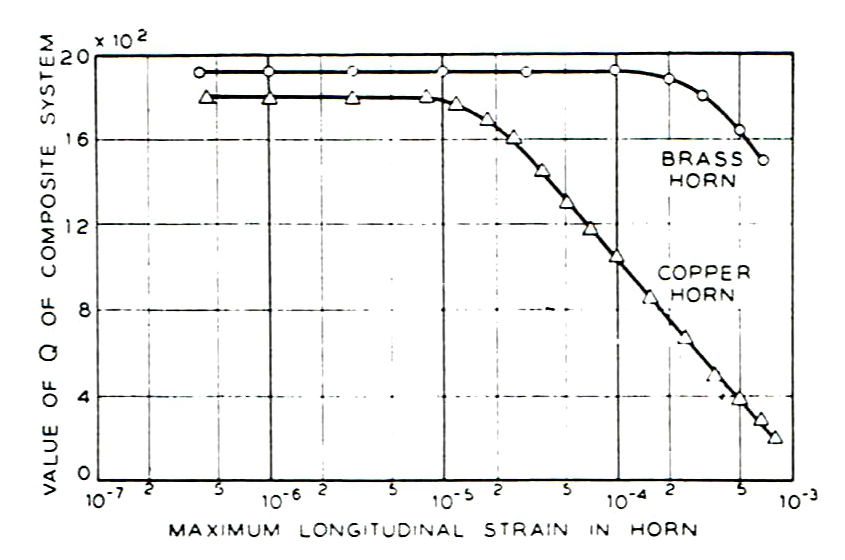
Mason 的超声试验(图 1)表明,在应变达到 1.0e-5 之前,铜的 Q 约为 1800,超过该应变后 Q 迅速下降。在应变达到 1.2e-4 之前,黄铜的 Q 约为 1900,超过该应变后 Q 迅速下降。作为对比,Ti-6Al-4V 在应变达到 3e-3 之前 Q 约为 20000。
|
|
|
导热性能好 - 用作后驱动块?
钟用黄铜
镍铝青铜(NAB)
Copper alloys
Overview
Copper and its alloys are not widely used because most have the following disadvantages —
- Relatively low quality factor Q (indicative of high loss)
- Low fatigue strength
- Low resistance to wear and cavitation
Mason's ultrasonic tests (figure 1) show that copper has a Q of approximately 1800 up to a strain of 1.0e-5 beyond which the Q decreases rapidly. The Q of brass is approximately 1900 up to a strain of 1.2e-4 beyond which the Q decreases rapidly. For comparison, Ti-6Al-4V has a Q of approximately 20000 for strains up to 3e-3.
|
|
|
Good thermal conductivity - back driver?
Bell brass